Decibel #2

Author’s note: I’m still trying to figure out how to structure the links and thoughts. With a short, medium, and long section, I could have section names that repeat every edition, or I could just omit them and just use the link titles (as I did last week). Let me know what you think is better and why.
TLDR: Reverse Time Universe
I love the red button text on this one.
A Few Thoughts: How I Used DALL·E 2 to Generate The Logo for OctoSQL
Watching someone build something the whole way through gives a lot of opportunities for learning and for curiosity to arise. Jacob does a great job showcasing that here.
My GMTK Game Jam 2022 submission also used DALL·E 2 to help me with the art. Tons of fun was had modifying my descriptions. Check out this “cartoon dwarf shopkeeper wearing armor rolling dice”, which was just perfect for a game structured around upgrading dice faces under a dwarven dungeon theme.

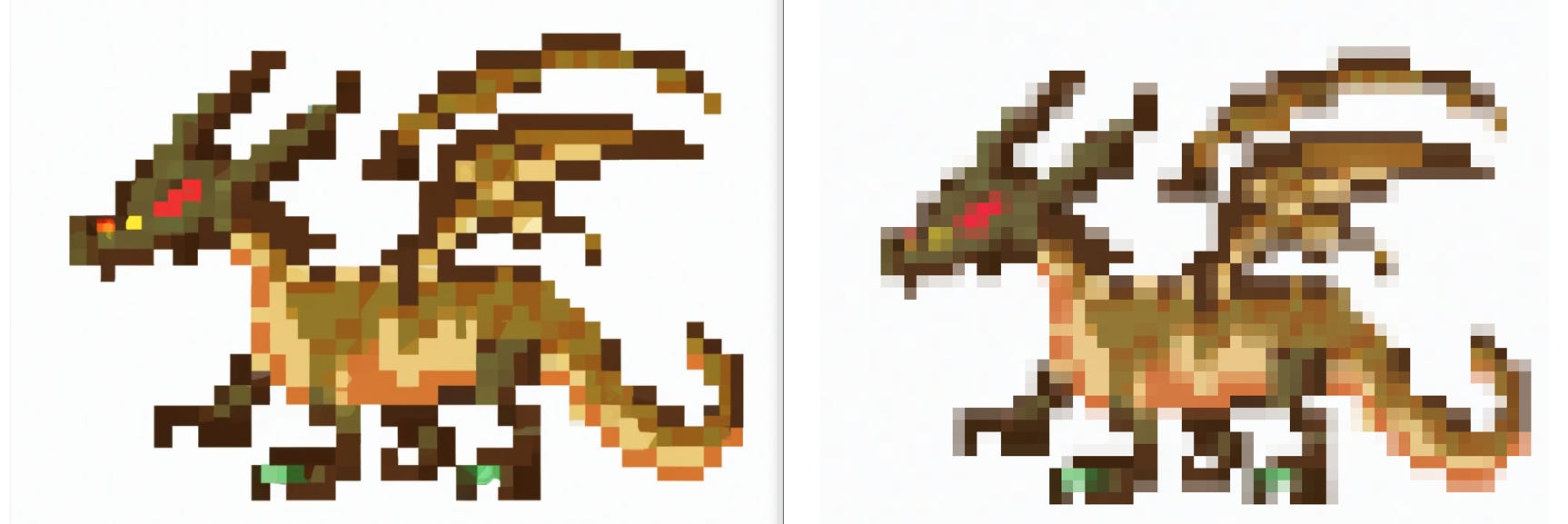
Quick improvements that I could make with little prior skill like re-pixelating this dragon allowed me to add a lot of fun art to the game jam — especially considering the 48 hour time limit.
Even adding simple animations turned out to not be too hard — and you can see from the comments on the game — the little goblin turned out pretty well.
I also highly recommend checking out this prompt book on DALL·E 2 if this above interests you.
Take Some Time: What You'll Wish You'd Known
I’m working my way through a list of recommended “evergreen” (essays that have an idea that is sticky for you) articles and this one from Paul Graham evoked a lot of response from me. Below I’m going to walk through my thoughts on the essay.
So I asked them, what do you wish someone had told you in high school?
I stopped before reading the essay and answered this question for myself. My initial reaction was: I didn’t feel like there was anything I wish I had been told. Upon further reflection, I came up with the following:
There are two phases of things I “wish” I had been told in high school (both of which I actually was told).
Freshman-Junior year: Try things. Take a photograph class. Ask your crush out. Pick up an instrument. Try a sport — especially if your friends aren’t already playing it.
Graduation seniors: Dr. Suess’s Oh, the Places You’ll Go!
The first teaches that failure is okay and there are a lot of parts of life that you might not be experiencing currently but that you would very much enjoy.
The second is about maintaining curiosity and wonder and continual effort.
When I ask people what they regret most about high school, they nearly all say the same thing: that they wasted so much time. If you're wondering what you're doing now that you'll regret most later, that's probably it.
This surprised me a lot. I don’t feel like I wasted much time at all in high school. I’m curious what the distribution of answers looks like for this question across a large number of people.
The reason [playing/hanging-out] got stale in middle school and high school, I now realize, is that I was ready for something else. Childhood was getting old.
Childhood still hasn't gotten old to me. Play and exploration and carefree days are still a delight. Maybe it’s a flaw, but it does feel like part of who I am.
Hanging out with friends is like chocolate cake. You enjoy it more if you eat it occasionally than if you eat nothing but chocolate cake for every meal.
This analogy treats friends as the sugary treat that is not good for you — it's only something to be occasionally enjoyed, rather than the soul-nourishing, meaning-creating activity that I find it to be. Hanging out with my friends is consistently one of the best parts of my life. When I think about which days are my favorite, or have had the most meaning, they are always ones with friends and people I care about. Trying to steelman Paul's argument, I admit that time spent with friends has does have diminishing marginal value, but not enough that I think that I can agree with this analogy.
> Rebellion is almost as stupid as obedience. In either case you let yourself be defined by what they tell you to do. The best plan, I think, is to step onto an orthogonal vector. Don't just do what they tell you, and don't just refuse to. Instead treat school as a day job. As day jobs go, it's pretty sweet. You're done at 3 o'clock, and you can even work on your own stuff while you're there.
Solid advice.
> Kids are curious, but the curiosity I mean has a different shape from kid curiosity. Kid curiosity is broad and shallow; they ask why at random about everything. In most adults this curiosity dries up entirely. It has to: you can't get anything done if you're always asking why about everything. But in ambitious adults, instead of drying up, curiosity becomes narrow and deep. The mud flat morphs into a well.
I really enjoyed this dissection of the forms of curiosity.
> One of the most dangerous illusions you get from school is the idea that doing great things requires a lot of discipline.
Requires is the relevant word here — requires, no, but helpful, almost certainly yes. Almost all of the experts I know have a form of discipline. That discipline doesn’t need to be about sheer number of hours spent, but there is a quality or mindset to excellence that is important.
> When a friend of mine used to grumble because he had to write a paper for school, his mother would tell him: find a way to make it interesting.
I found this to be particularly clever advice for approaching the undesirables in life. I expect I will remember this one for a while.
Overall, I found this essay to not be one of his best pieces (Paul has several great essays), but I enjoyed the read and hope you did too.
I particularly enjoyed your last link, "Take Some Time: What You'll Wish You'd Known" and your comments to it in this edition.
Here is an interesting article from Austin Kleon, entitled "Water in the Well", around Ernest Hemingway's comments around the source of writing creativity. https://austinkleon.com/2022/08/04/water-in-the-well/?r=2szb8&utm_source=substack&utm_medium=email
Loved this quote, "I learned never to empty the well of my writing, but always to stop when there was still something there in the deep part of the well, and let it refill at night from the springs that fed it." I thought it was a powerful point of view -- not to drain our creativity dry but allow it to refresh from itself.